
CROATA LIFE
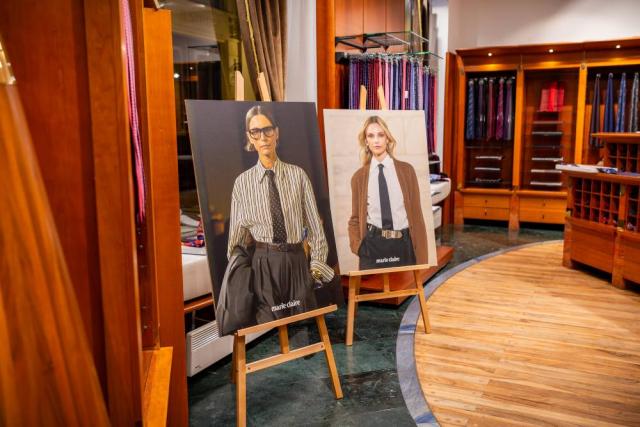
The tie is once again strongly present in women’s fashion.Across runways, magazine covers and contemporary city silhouettes, it is no longer merely an unexpected detail borrowed from a man’s wardrobe. It is worn with generous suits, open shirts, dresses and knitwear. At times, it is tied with precision; elsewhere, lowered or left almost like a long silk ribbon.The same object assumes a different character each time. This contemporary perspective brought Marie Claire and Croata together for “Powerful Women Wear Ties.” At the Croata Oktogon boutique, the women’s tie was considered not only as a fashion direction, but as an object to be understood at close range: through silk, construction, colour, knot and individual interpretation.
Beyond the masculine suit
The women’s tie is still frequently described as an adoption of a masculine dress code. Yet on a female silhouette, it need not simply repeat that code. It changes its proportion and mood. Beside a generous jacket, it may remain narrow and precise. With a softer shirt, the knot may be relaxed and the ends worn shorter or asymmetrically. With a dress or knitwear, the tie is no longer part of a formal composition, but a clear line of silk giving the clothing another rhythm. Its strength does not lie in making a woman appear more severe or authoritative. It offers her another possibility of choice.
The knot changes the character
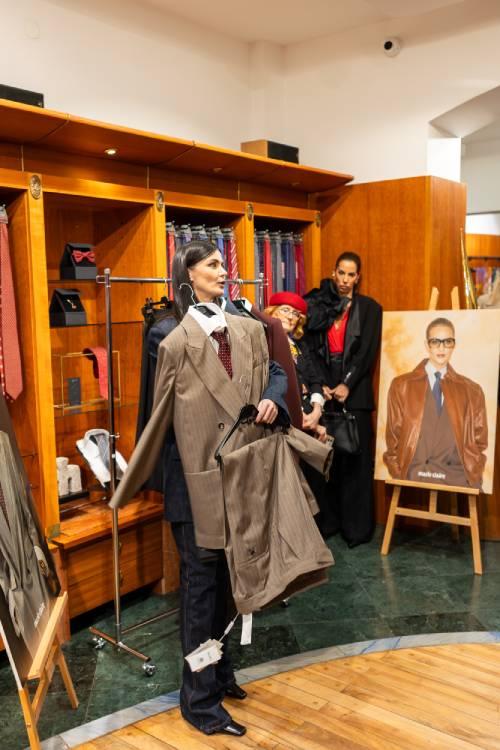
A small difference in knotting may alter the entire image. A knot placed high against a closed collar retains the precision of classic dress. Lowered or softened, the tie loses part of its expected formality. Worn more freely, its end approaches the character of a scarf or a silk ribbon. Through the practical act of tying, the Marie Claire x Croata gathering revealed how many interpretations may exist within a single object. The intention is not to discover one correct feminine knot. It is to find the relationship that corresponds with the individual, her clothing and the way she wishes to move through the world. The tie may follow a rule. It may also change it quietly.
Colour close to the face
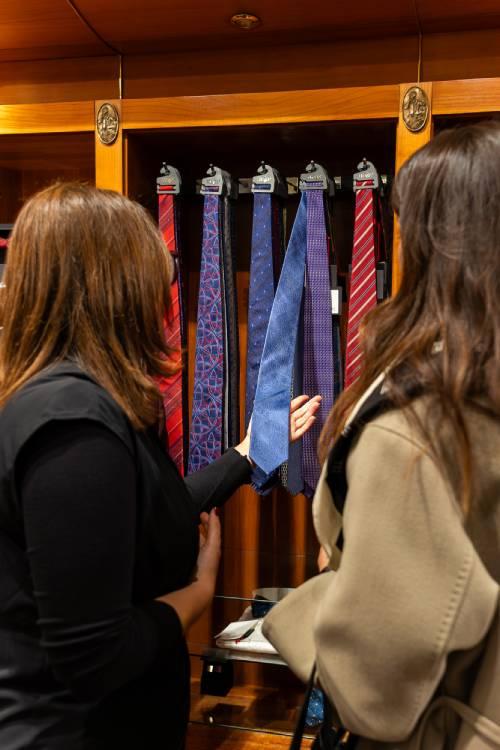
The tie occupies a position in which even a small alteration has a pronounced effect. Placed close to the face and neck, its colour may illuminate the entire silhouette, deepen the tones of a dark suit or interrupt a neutral surface with one precise accent. A red tie against black or white feels direct. Navy worn with a suit in a related shade creates a calm, almost uninterrupted line. A small motif introduces rhythm visible only at close range, while a larger pattern becomes an important graphic element of the entire composition. The Marie Claire styling perspective demonstrated that a tie does not need to match every other detail literally. Its presence needs to feel intentional. This is the distinction between an accessory that has merely been added and an object that defines the character of the clothing.
Silk made to receive a knot
A tie is first selected through sight, yet its quality is understood through touch and wear. Silk must receive the knot without losing softness. The internal construction must create balance without making the object rigid. After wear, the surface should recover its form and the edges remain composed. A tie is therefore more than an elongated surface of silk carrying a motif. It is a constructed object whose value becomes clear through movement. Croata brings to this experience its knowledge of silk, cut and finishing. Marie Claire introduces a contemporary fashion perspective and the question of how the object may be worn beyond expected boundaries. The meeting of these two perspectives does not create a new rule. It opens more possibilities.
In her rhythm
A tie worn by a woman does not always need to make a statement about authority, gender roles or the deliberate rejection of convention. At times, it is simply the right object for a particular silhouette. It may remain almost invisible within a dark composition or become its only pronounced element. It may retain classic precision or lose its regularity. It may be tied carefully or worn with the ease of a silk scarf. Its meaning is not predetermined. It is created anew through the relationship between colour, knot, clothing and individual. The tie no longer belongs only to one wardrobe. It belongs to the woman wearing it — in her rhythm.