
CROATA LIFE
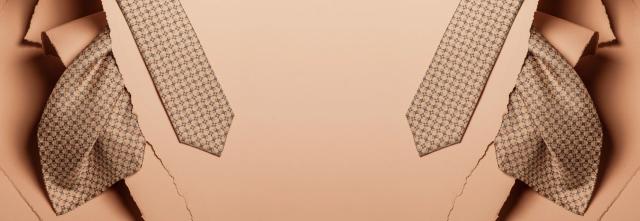
A tie is most often observed from the front. Colour appears first, followed by pattern, the natural lustre of silk and its relationship with a shirt or suit. The interior remains concealed, treated as a technical part of the object about which the wearer need not think. Croata 7 begins precisely where the gaze usually ends. Its distinction lies not only upon the surface of the silk, but in the way the entire tie is formed. Its exterior and interior are shaped in seven stages from one silk fabric, creating a particular multilayered construction. At the same time, each pattern and colour combination is produced in only seven examples. The number seven therefore carries two meanings. It defines both the method of construction and the boundary of the edition.
A construction revealed from within
In a well-formed tie, construction should not draw attention to itself. Its role is to allow the surface to remain composed, the tie to receive a knot correctly and the fabric to fall naturally along the front of the shirt. The interior of Croata 7, however, deserves to be seen. When the tie is opened, layers of silk are revealed that no longer function merely as support for the exterior pattern. They participate in shaping the entire object. What is usually a concealed technical element becomes one of the clearest expressions of how the tie was made. This does not mean that Croata 7 needs to be worn open or that its interior should be displayed on every occasion. Quite the opposite. The value of its construction lies in remaining discreet while defining the experience of the entire tie.
More silk is not enough
A greater quantity of a precious material does not in itself create a better object. Silk needs to be distributed, folded and shaped correctly. Every layer must have a purpose, while the final construction must remain balanced. Excessive rigidity would remove the natural movement of the tie. Insufficient structure would fail to give its form sufficient clarity. The measure of a good tie is found between these two extremes. In Croata 7, silk is more than the exterior surface carrying the design. It also assumes part of the structural role. The choice of fabric is therefore particularly important. Its density, suppleness, touch and response to folding must correspond with an object formed through several layers. Only when material and construction are properly aligned does the complexity of making disappear into the simplicity of the finished form.
The knot as the final test
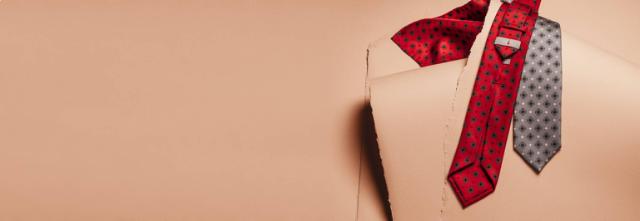
A tie can be fully understood only once it is tied. Upon a flat surface, it is possible to assess colour, pattern and precision. The knot reveals something else: how the fabric gathers, how much space it occupies, whether it retains clarity and how it continues into the vertical line of the tie. Within a multilayered construction, every fold affects the whole. The knot is therefore more than the final act of dressing. It is the moment in which the balance between silk, construction, width and the chosen method of tying becomes visible. Croata 7 does not necessarily require the most complex or the largest knot. It requires a knot that allows the construction to reveal its measure. With a higher or more open collar, it may be tied more fully. Within a narrower collar opening, the knot should remain quieter. As with every well-made tie, the objective is not to demonstrate everything that can be achieved, but to find the relationship in which each element appears natural.
The pattern after tying
The pattern of a tie is never experienced in the same way as a design upon an open field of silk. Part of the motif enters the knot. Another part remains within the central line, while individual elements approach the edges or disappear inside the folds. A well-conceived tie pattern is therefore more than an image. It must continue to function after the surface has been folded, narrowed and tied. The Croata 7 line includes classic and thematic designs. Some are based upon geometry, rhythm and restrained colour relationships. Others carry Croata motifs connected with art, culture and Croatian heritage. The current selection includes classic and thematic versions presented with a corresponding silk pocket square. The particular construction should not overpower the design. It should give the design the form within which it can be seen most convincingly.
Tie and pocket square
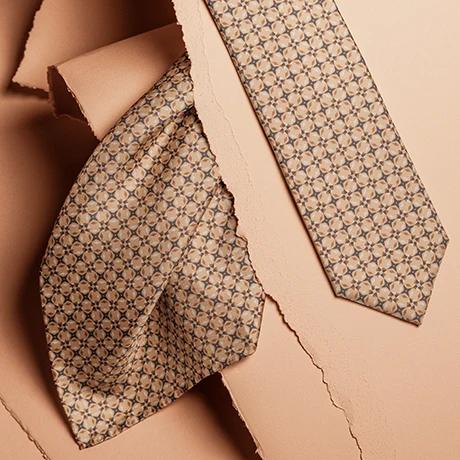
Croata 7 is conceived through the relationship between the tie and its pocket square. The pocket square carries the silk and character of the chosen design into another part of the composition. The two objects, however, need not always be worn as a completely matching pair. The tie may remain the leading element, while the pocket square is folded to reveal only an edge, one colour or a small fragment of the motif. The relationship remains visible without making the composition appear predetermined. Within more formal dress, the pocket square may remain almost silent. In a more personal interpretation, it may reveal a greater part of the design. The value of the pair lies not in an obligation to wear both pieces together, but in the possibility of interpreting the same textile idea in different ways.
Seven examples
Croata 7 is made in an edition of only seven ties sharing the same pattern and colour combination. This rarity is important, but it is not sufficient to explain the object. The number seven acquires meaning because it is connected with the whole: original design, particular construction, silk and the method of making. The edition is not limited merely for the sake of being small. Its boundary preserves a precise relationship between pattern, colour and construction. Seven individuals may own the same version, yet each tie remains part of a clearly defined and completed series. Croata 7 therefore belongs to the connoisseur who does not search for rarity only upon a label. They search for it within the object.
What need not be displayed
The most valuable detail of Croata 7 will not always be visible to the person standing opposite. They will see colour, pattern, knot and the way the tie completes the clothing around it. They may not know how its interior was formed or how many decisions lie behind its composed exterior line. This is not a weakness. Good construction does not require constant explanation. Its value is experienced through the object as a whole. Croata 7 demonstrates that the luxury of a tie need not reside in what is most visible. At times, it is found within seven folds of silk that remain concealed — yet without which the tie would not be the same.