
CROATA LIFE
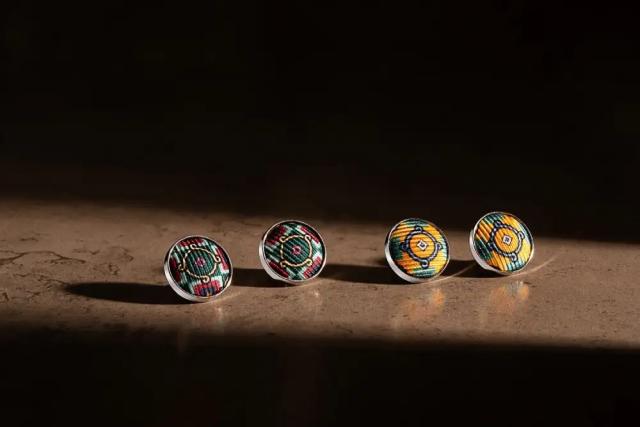
Jewellery is a small object, yet it is rarely without meaning. It may be chosen for its line, material or the way it rests beside the face and skin. It may mark a relationship, a moment or a personal preference. Often it becomes part of the individual so naturally that it is no longer perceived merely as an accessory, but as a recognisable personal sign. At Croata, jewellery is created at the meeting point between ornament and meaning. One part of the collection is shaped in silver through contemporary interpretations of motifs such as Croatian interlace and inspirations drawn from Dubrovnik jewellery traditions. Another brings precious metal together with silk, introducing Croata textile design into an object considerably smaller than a scarf, shawl or cravat. These are different expressions of the same idea: a motif is preserved not by remaining unchanged, but by finding a new form.
Two materials of a different nature
Silver and silk are almost opposites. Silver is firm. It can be shaped precisely, polished and resolved into a clear line. Silk is soft and mobile. Its surface changes with position, light and the angle from which it is observed.
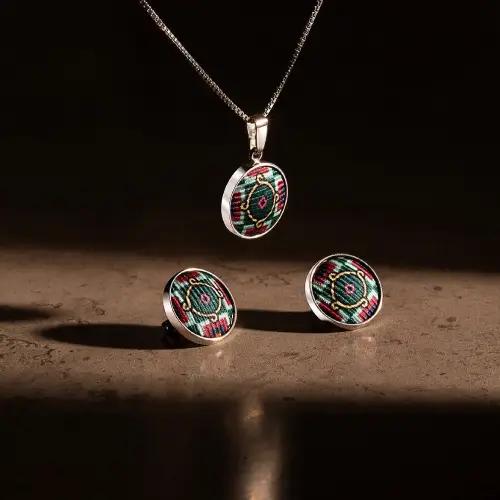
When the two meet, neither material should lose its character. Metal provides structure. It defines the object, its relationship with the body and the precision of each detail. Silk introduces colour, depth and pattern. It softens the coolness of metal while carrying something silver alone cannot convey: a textile composition developed within Croata’s design studio. The value of this combination does not lie in simply adding silk to a metal object. It lies in measure. The silk must remain sufficiently visible to be recognised as both material and design, yet precisely integrated enough for the object to retain the clarity of jewellery.
An entire design within one fragment
Upon a large silk scarf, a motif can be seen as a complete composition. There is a centre, a border, a rhythm of colour and a relationship between filled and open space. When the same textile language enters jewellery, the available surface becomes far smaller. The entire design can no longer be shown. What remains is a fragment. A few lines, a passage of colour or a section of motif enters a silver frame and becomes a new composition. What was one detail upon a scarf becomes the centre of an entire pendant, earring or necklace. For this reason, two pieces cut from the same silk surface need not appear completely identical. The position of the textile determines which part of the design remains visible, allowing the character of each object to vary slightly. Not as an accident, but as a consequence of the material itself. Silk is not a printed reproduction placed over jewellery. It is part of the object.
A motif that changes material
Another part of Croata jewellery contains no silk. Its distinction lies in the way a motif is translated into metal. Croatian interlace naturally lends itself to such an interpretation. Its lines cross, continue and return, creating a rhythm without an obvious beginning or end. For centuries, it appeared in stone as an ornament of architecture and monuments. In jewellery, it becomes smaller, closer to the body and more personal. It is not worn as a historical illustration. It is worn as a contemporary line whose depth need not be explained at first glance.
A similar process applies to Glagolitic script. A letter may be understood as a sign of language and culture, but in design it also becomes geometry, a relationship of filled and open surfaces and a recognisable rhythm. When a motif is transferred into jewellery, it is not enough merely to reduce its original form. It is necessary to decide what within it is essential. Is it the interweaving, repetition, a particular line or a sense of continuity? Only then does heritage cease to be decoration and become contemporary form.
A trace of Dubrovnik goldsmithing
Part of Croata’s jewellery collections also draws upon the traditions of Dubrovnik jewellery. For centuries, Dubrovnik developed its own culture of dress, gift-giving and goldsmithing. Jewellery there was never only ornamental. It spoke of belonging, family, occasion and one’s relationship with the city. A contemporary interpretation does not need to reproduce a historic object in every detail. It may instead carry its logic: the refinement of metalwork, the rhythm of interwoven elements, a sense of continuity and the discipline with which richness of detail is kept under control. The result is an object that does not resemble a replica. Its origin is present, yet does not restrict it.
When jewellery changes silk
A particular place between jewellery and the silk accessory belongs to the scarf ring or scarf clip. Such an object is not merely decorative. It changes the way silk is shaped and worn. A scarf that might otherwise be tied in a knot can pass through a metal form, be gathered closer to the neck or arranged to reveal a different part of the design. One clip can open several interpretations of the same scarf without complex tying and without losing the natural fall of the silk.
Here, jewellery does not simply sit beside the silk object. It participates in its form. Metal defines one point while silk remains free around it. Firmness and softness meet once again, this time not only within a single object but within the act of wearing it.
An object observed closely
A cravat, shawl or large scarf may shape the impression of an entire silhouette. Jewellery works at a shorter distance. It is revealed beside the face, upon the neck, wrist or within the movement of silk. Its value therefore depends upon details that cannot be concealed: clarity of line, the finish of the metal, the relationship of size and proportion, the mechanism of a fastening and the precision with which different materials are joined. A small format does not mean a simpler task. On the contrary, the smaller the object, the more visible every relationship becomes.
One line may feel too heavy. Too much silk may conceal the metal. Too little may reduce the textile to an insignificant insert. A motif that is powerful across a large surface may require a quieter selection within jewellery. A convincing result is achieved when nothing appears added afterwards. When the object is not divided into a metal part and a silk part, but experienced as a whole.
More than ornament
The story accompanying Croata jewellery speaks of the meeting of desire and beauty, art and craft, ornament and sign. That final distinction is the most important. Ornament attracts the eye. A sign remains in memory. Croata jewellery does not need to explain the origin of its motif or the rarity of its materials every time it is worn. Above all, it must be contemporary, wearable and convincing as an object.
Only then does its story acquire full value. Silver may retain a trace of interlace, Glagolitic script or Dubrovnik jewellery traditions. A fragment of silk may reveal the colour and rhythm of Croata textile design. The object is small. Yet what it connects may be much larger: material and motif, past and present, ornament and meaning. Between silk and silver, jewellery is created not only to be seen. But to keep something personal close.