CROATA LIFE
We usually recognise the tie through its function.
It is knotted around the neck, paired with a shirt and associated with ceremony, business and moments of significance. Its form is so familiar that we rarely stop to look at it closely. Yet it was precisely within this apparent familiarity that the American sculptor Nicholas B. Daddazio found a subject to which he would devote a substantial part of his artistic practice.
For Daddazio, the tie was never merely an accessory.
It became line, volume, movement and sign: an object that could be removed from its usual context.
Looking at the everyday
Daddazio’s artistic path developed in New York, where, after working in the theatre, he studied sculpture and spent almost a decade in the studio of sculptor Domenico Facci. In 1992 he opened his own studio at Pietrasanta Fine Arts in SoHo, continuing his work in figurative sculpture while beginning an intensive exploration of the necktie as a symbol and cultural icon.
At first, the choice of subject may seem unexpected.
What remains of the tie when it is separated from the shirt, the collar and the person who wears it? Is its elongated form simply the result of function, or does it already possess an independent sculptural quality? Can a piece of fabric become a figure?

The tie as a body in motion
Daddazio found his answer in a form capable of continual transformation.
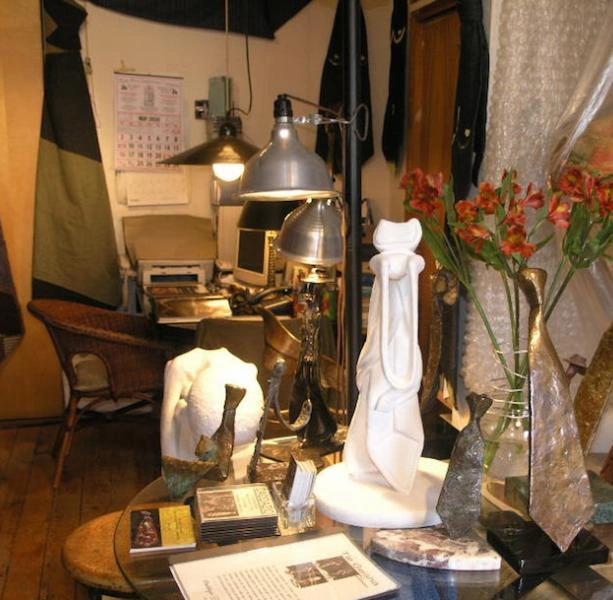
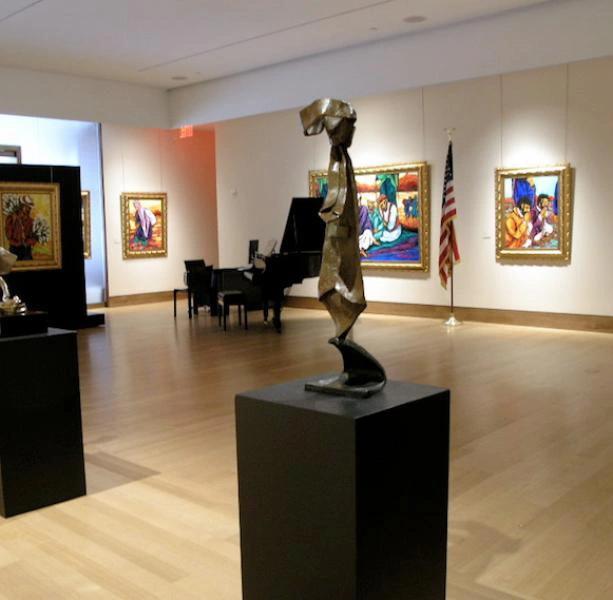
A tie can recline, bend, dance or assume the posture of the human body. It can evoke a musician, a ballerina or a figure caught in movement. His work developed into an extensive group of bronze sculptures with titles including Reclining Tie, Tie Saxophonist, Tie Ballerina, Tie Geisha and Tie Trumpet.
The recognisable form of the tie never disappears from these works.
On the contrary, it becomes the point of departure. Its pointed end may become a foot, a fold may suggest the movement of a body, and the knot may become a head or the centre of a sculptural composition.
Daddazio does not take away the tie’s identity. He reveals how many possible meanings are already contained within its shape.
From object to cultural sign
Throughout its history, the tie has been far more than a practical element of dress.
It has expressed belonging, role, ceremony and an attitude towards a social occasion. It has appeared in offices, state institutions, schools, formal rituals and private moments of importance. Its width, length, materials and methods of knotting have changed, yet it has remained one of the most immediately recognisable forms in modern dress.
Daddazio was therefore interested in the tie not only as a fashion object, but as an icon of Western culture and a social sign. His work considers a form adopted by countless people, institutions and cultures, each of which has given it a different layer of meaning.
There is always a relationship between the person and the tie.
It may affirm belonging, yet it can also express individuality. It may be strict or playful, almost invisible or deeply personal. It may follow convention, while colour, motif and the manner in which it is worn can quietly transform that convention.
This space between social code and personal expression is what makes the tie an enduring artistic subject.
Sculptures that leave the plinth
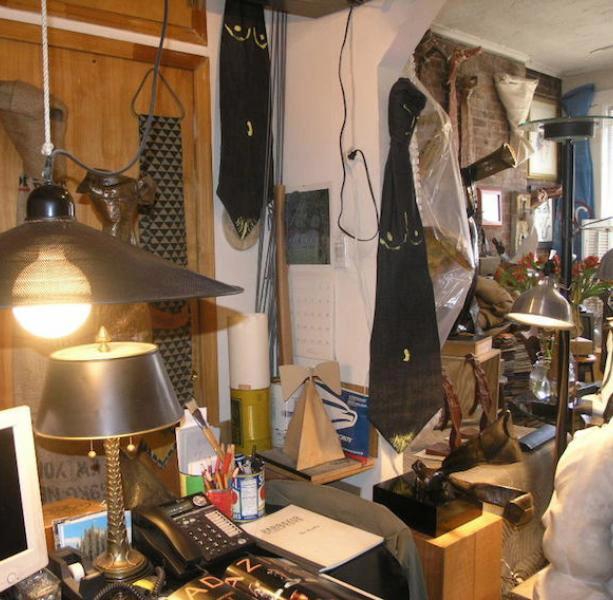
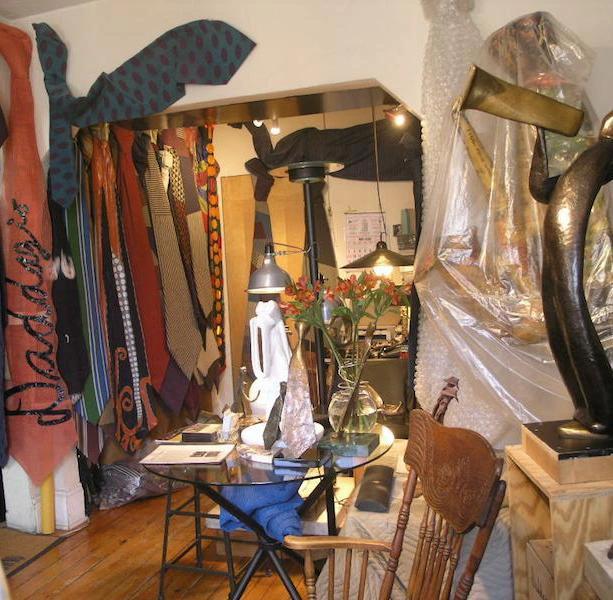
In 2005, Daddazio began creating monumental tie sculptures measuring approximately 1.2 to 2.7 metres in length. Rather than relying on traditional sculptural materials, he worked with awning canvas, denim, plastic sheeting, bubble wrap, netting, tarpaulin and fabrics intended for furniture.
Changing the scale transformed the viewer’s relationship with the object.
The tie was no longer something worn by a person. It became larger than the body.
It could hang from a ceiling, cross a doorway, follow a staircase, rest on furniture or occupy an entire wall. These monumental ties did not need a conventional plinth. They entered the surrounding space and altered it, functioning at once as sculpture, textile object and installation.
The familiar object began to feel almost architectural.
Material changes meaning
Silk gives a tie softness, lustre and precision of movement. Bronze gives it weight and permanence. Denim, plastic, netting and coarse canvas introduce entirely different associations.
By changing the material, Daddazio demonstrated that the tie’s identity does not depend solely on the fabric from which it is made. Its form is strong enough to remain recognisable even when created from materials that appear to contradict its customary refinement.
Each material changes its character.
A bronze tie may resemble a monument. One made from transparent film can appear fragile and temporary. A version in coarse canvas loses its expected formality, while a tie constructed from netting becomes almost a drawing in space.
The same form speaks a different language each time.
In 1994, the Neckwear Association of America commissioned Daddazio to design a new awards trophy, beginning a collaboration that continued for almost a decade. Further commissions, solo exhibitions and presentations followed, as did the opening of the Necktie Sculpture and Art Gallery on Cornelia Street in Greenwich Village in 1996.
His sculptures later entered private collections connected with prominent figures and houses in fashion, including Ralph Lauren, Tommy Hilfiger, Kenneth Cole, the Versace estate and the Forbes family.
Daddazio’s work exists precisely at the meeting point of fashion and art. He does not attempt to turn the tie into something it is not. Instead, he takes its real history, social role and recognisable form and transfers them into another medium.
In his hands, the tie does not cease to be a tie.
An object shaped by the person who wears it
Every tie begins as a length of fabric.
Only through knotting does it acquire volume. Only through wearing does it enter into a relationship with the body. Only through the choice of colour and motif does it become part of an individual expression.
Perhaps this is why it is so close to sculpture.
Sculptural material also begins without a final form. It acquires one through touch, decision and the movement of the hand. The difference is that a tie is shaped again each day. Its knot is never entirely identical, and its fall depends upon its fabric, construction and the person who wears it.
Daddazio recognised the artistic potential within this everyday gesture.
For him, the tie is a form that the artist does not complete alone.
It is completed by the person who gives it movement.
Seeing the familiar with different eyes
The value of Daddazio’s work lies not only in enlarging the tie, casting it in bronze or transforming it into a figure.
Its importance lies in a change of perspective.
He showed that an object encountered almost every day can contain an unexplored artistic value. That the familiar is not necessarily exhausted. And that the boundary between a functional object and a work of art can sometimes depend only on the way we choose to look at it.
In his sculptures, the tie retains traces of the world from which it comes: dress, culture, ceremony and personal identity.
Yet it becomes something more.
A body. A movement. A sign in space. And a reminder that art is sometimes found not in what we have never seen before, but in what we have seen countless times without ever truly noticing