
CROATA LIFE
A shirt is one of the quietest elements of menswear. Its value should not depend upon a large decorative gesture. It is recognised through cut, material, the clarity of the collar and the way the shirt retains its line throughout wear. This is precisely why the shirt is such a demanding place for a motif. A sign that is too pronounced can easily take over the entire object. A detail added only for decoration remains separate from the shirt’s real value. The new Croata Dubrovnik shirts begin with a different idea: Croatian heritage is not applied to a completed shirt but introduced into the structure of the fabric itself. The first patterns feature Glagolitic script, Croatian interlace and squares. They open a collection that will continue to develop through new motifs, while retaining the same essential principle - the shirt must first remain a contemporary, well-designed and wearable object. Only then can the motif acquire its full meaning.
A motif revealed at close range
On a Dubrovnik shirt, the motif is not an image printed upon the surface. At first, it may appear only as a change within the structure of monochrome fabric. From another angle, it becomes clearer. Light reveals geometry, a letter or an interwoven line before allowing it to recede once again. From a distance, the shirt may therefore appear entirely restrained. The motif emerges only when approached more closely - within the fold of a sleeve, beside the collar or across a surface touched by light. Heritage is not transformed into a loud label. It remains present while becoming part of the personal style of the wearer.
Glagolitic script as a visual language
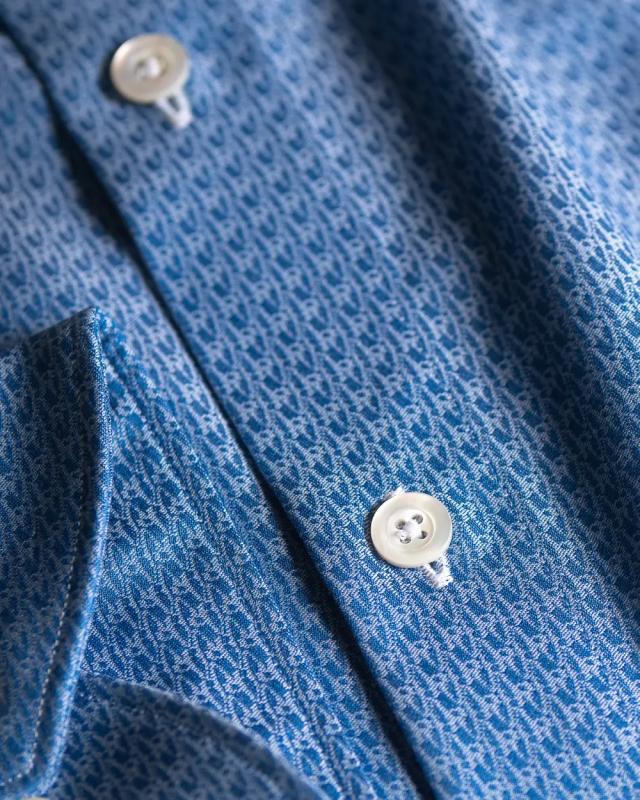
Within the new collection, Glagolitic script does not appear as text that must be read or as a large letter taking over the shirt. Its forms become rhythm.
The rounded and angular lines of the characters create a surface that can be observed at two levels. From a distance, it remains calm and almost geometric. At close range, its cultural origin is revealed.
Glagolitic script therefore moves beyond an expected historic setting and enters contemporary dress without losing its identity.
The shirt carries a sign, but never becomes a costume.
Interlace in movement
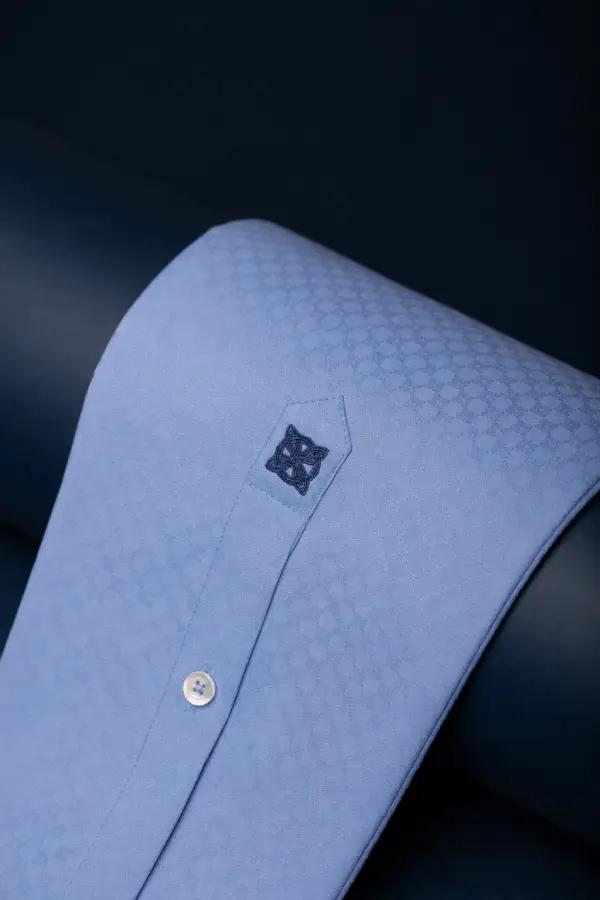
Croatian interlace is formed by continuous bands that connect without a clearly defined beginning or end.
Upon the shirt, the motif takes on a lighter character. The lines are no longer carved into stone but move together with the fabric and body.
As the sleeve bends, the shirt shifts beneath a jacket or light travels across its surface, the interlace does not remain static. Its rhythm is composed again each time.
A motif associated with continuity and connection becomes a natural part of an object intended for everyday life.
Squares beyond literal interpretation
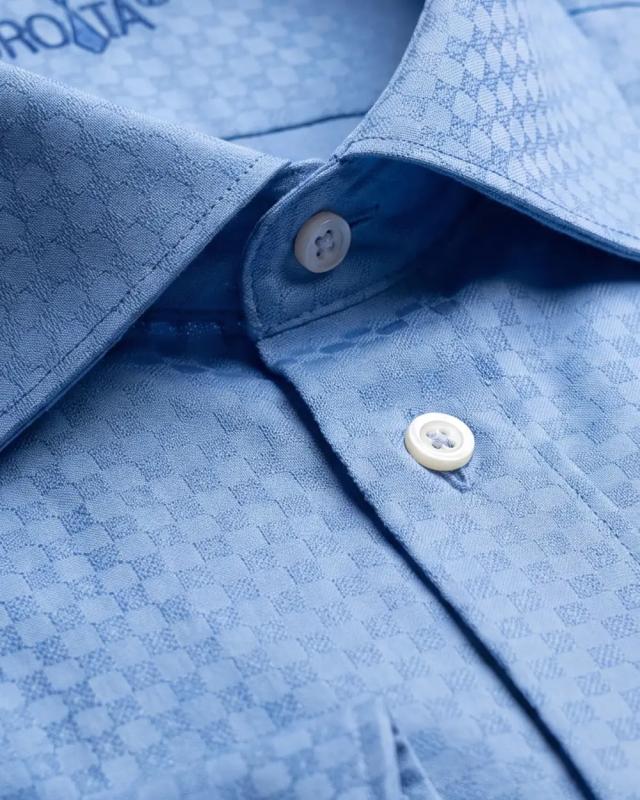
Squares are among the most recognisable Croatian visual signs.
On the Dubrovnik shirt, they do not appear as a large or direct emblem. Within the fabric, they become a rhythm of full and open areas, light and shadow.
The geometry is first experienced as structure and only later clearly recognised.
This interpretation gives a strong motif a quieter role. The shirt may be worn in business, ceremonial or less formal surroundings without requiring the entire ensemble to be built around its symbolism.
Identity remains present.
It does not need to be announced from a distance.
A collection that continues
Glagolitic script, interlace and squares do not form a closed list of Dubrovnik patterns. They establish a design direction capable of receiving further themes connected with Croatian culture, art, architecture and place. Future motifs may begin with a letter, ornament, architectural detail or recognisable geometry. Some may be clearer, while others may almost disappear within the tonal surface of the fabric. They will share more than Croatian origin.
They will be connected by the way in which each motif is translated into a shirt: without literalness, excess or separation from the garment’s essential purpose.
Material before message
Dubrovnik shirts are made from 100 per cent combed Egyptian cotton in a 2-ply construction. Two yarns are combined before weaving, giving the material body, smoothness and stability while retaining the comfort of natural cotton. This is particularly important in a fabric that carries a motif. Its value cannot be judged only while the material lies flat. It must remain clear and composed within the completed shirt and in its relationship with the collar, cuffs, seams and movement of the body. Natural mother-of-pearl buttons are individually sewn by hand. Their surface changes under light without creating a sharp contrast against the fabric. Like the motif, they reveal themselves at close range.
Developed and made in Croatia
Croata retains the development of design, pattern construction and shirt production in Croatia. This allows motif, material, cut and finishing to remain connected rather than being treated as separate elements. The textile designer must understand how the fabric will be cut and joined. Pattern construction must take the arrangement of the motif into account. Production must preserve its rhythm across the collar, sleeves, cuffs and front of the shirt. The value of Croatian production lies in more than the location in which the shirt is made. It lies in responsibility for the entire process and in knowledge that remains connected with the finished object.
The shirt before the motif
The greatest challenge of a shirt carrying a cultural motif is ensuring that its story does not become the product’s only reason for existing. A Dubrovnik shirt must remain convincing before the meaning of the Glagolitic script, interlace or squares is explained. It must fit correctly. The collar must retain its line. The sleeve and cuff must be properly shaped. The fabric must remain comfortable, while the shirt combines naturally with different suits, trousers and accessories. It may be worn with a cravat, but it does not depend upon one. Beside a restrained plain cravat, the motif remains discreet. Without a cravat, the larger visible area of fabric allows the pattern to assume a slightly stronger role. There is no need to combine it with a cravat or pocket square carrying the same motif. A simpler accessory is often the best way to preserve the character of the shirt.
Identity within the structure
There is a difference between an object upon which a recognisable sign has been placed and an object with an identity of its own. The new Dubrovnik shirts belong to the second direction. Glagolitic script, interlace and squares are not separate messages added to the surface. They become part of the fabric, construction and everyday experience of wearing the shirt. The motif is revealed through changing light, within the fold of a sleeve and in the moment when geometry briefly emerges from the calm surface of the fabric. This is where the character of the Dubrovnik line is found. Not in presenting heritage loudly, but in making it a natural part of contemporary dress.