
CROATA LIFE
A wedding does not require the greatest number of decorative details, but a small number of considered decisions. The shirt, cravat, waistcoat, pocket square and cufflinks should distinguish the groom while remaining faithful to his character. There are days for which clothing is chosen differently. Not because it needs to be louder, richer or removed from personal style, but because it should make clear that the moment is not an ordinary one. Celebration is one of the ways in which people distinguish what matters from everyday life. It expresses more than a relationship with one’s appearance. It also communicates care for another person, for the gathered community and for the promise being made publicly that day. A wedding is precisely such a moment. The clothing belongs simultaneously to the individual, the ceremony and the memory that will remain in photographs. What is chosen should look right on the day itself, yet retain its measure many years later. Within menswear, that difference is often created through several apparently small elements: a shirt, cravat or bow tie, pocket square, cufflinks and, at times, a silk waistcoat. Each has its own role. None should attempt to carry the entire composition alone.
The groom should be recognisable, not disguised
Wedding attire is often approached through the question of how the groom should be distinguished from the other guests. A distinction is necessary. It confirms his particular role within the ceremony. It does not, however, need to be created through the brightest fabrics, the greatest number of accessories or a combination of elements he would never otherwise choose. The groom should appear as the most ceremonial version of himself, not as someone else for a single day. For a man whose style is based upon clean lines and restrained colour, a distinguished silk cravat, a precisely chosen shirt and personal cufflinks may be sufficient. For someone naturally drawn to a more expressive approach, a richer design, silk waistcoat or bow tie may assume a greater role. The essential requirement is a clear hierarchy. One element leads. The others support it. When the cravat carries a strong Croata motif, the pocket square need not repeat the entire design. When the silk waistcoat is rich in colour or pattern, the cufflinks and other metal details may remain quieter. When the bow tie already provides a distinctive character, there is no need to add a decorative tie pin. Celebration is not measured by the number of objects worn. It is measured by the care with which they were chosen.
The shirt as a composed foundation
The most visible elements often receive the greatest attention, yet the entire combination begins with the shirt. It determines the position of the collar, the space available for the knot, the relationship with the jacket and the way in which the cuffs and cufflinks will appear. If its cut, sleeve length or collar are incorrectly chosen, even the finest cravat will struggle to establish balance. A white shirt remains the most reliable ceremonial foundation. It gives clarity and allows silk to take the central role. Reliability, however, does not mean that every white shirt is equally suitable for every man. The shade of white, the construction of the collar, the width of the cuff and the relationship between shirt and suit must be considered together. The wedding shirt should not attract attention before the groom does. Its quality is revealed in a different way: through the fabric, precise fit, composed collar and the small section of cuff that appears beneath the jacket sleeve. It is the quiet surface upon which the remaining details gain clarity.
A cravat is more than the wedding colour
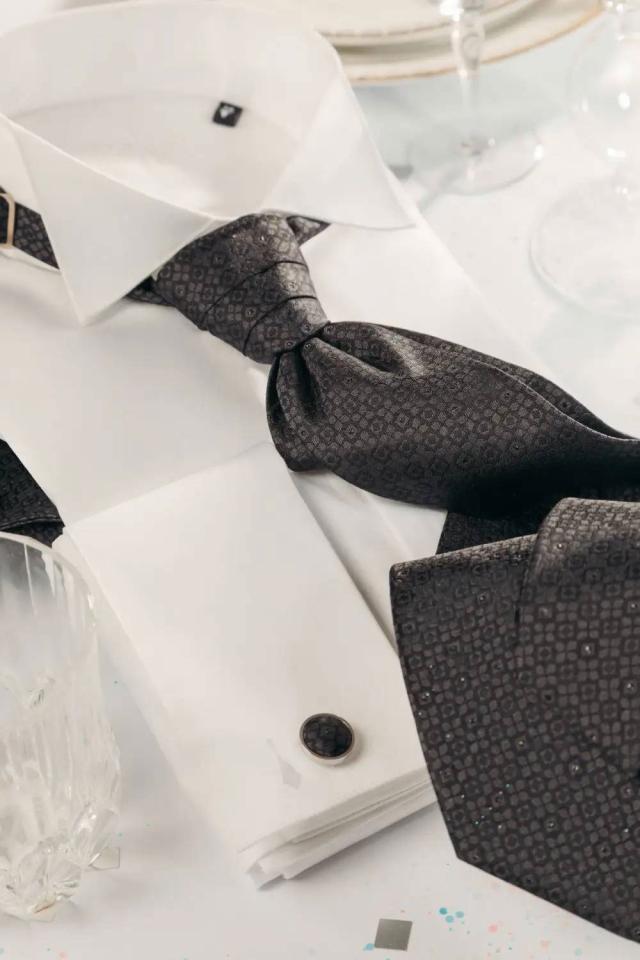
One of the first questions is often which colour the cravat should be. Colour matters, but it is not enough. The cravat should correspond with the suit, shirt, level of formality, time of day and character of the person wearing it. Its width should reflect the proportions of the lapels and the groom’s build, while the chosen knot should suit the collar. Plain or subtly textured silk can create a restrained sense of ceremony. Deeper shades of burgundy, blue, green or silver can give presence without excess. An original Croata motif can introduce a more personal character, particularly when it relates to a place, cultural reference, family story or symbol meaningful to the groom. Within a ceremonial moment, the cravat is more than a finishing accessory. It is a small sign through which a person demonstrates an understanding of the importance of the occasion. It need not be selected according to the decorations, nor should it literally repeat the colours of the flowers, invitations or entire wedding setting. The cravat belongs to the person and to the meaning of the day, not to the scenery. A good choice remains convincing even when removed from the context of a single event.
A waistcoat with a purpose
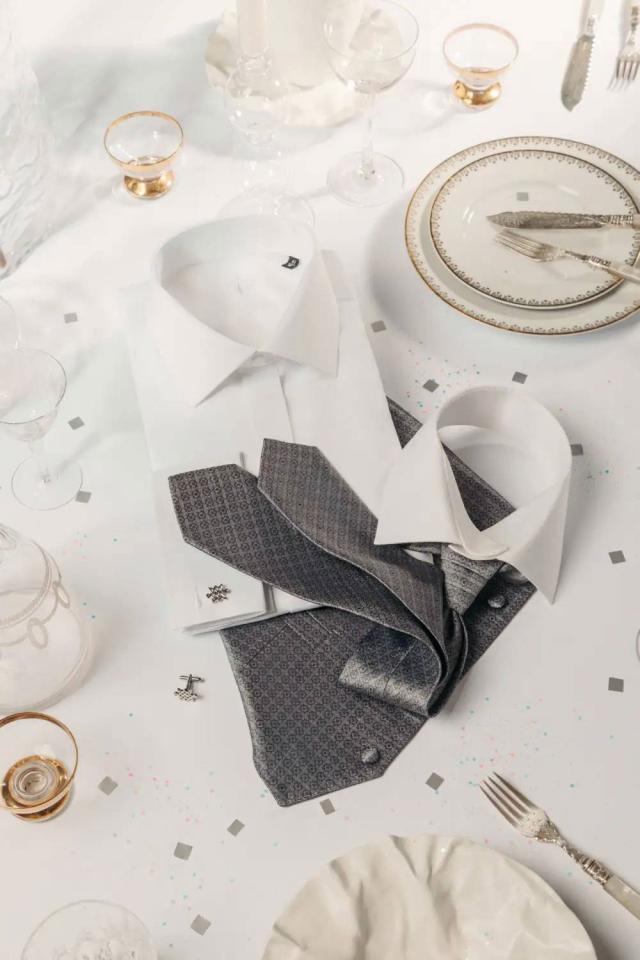
A waistcoat is not an obligatory part of a groom’s clothing. When selected, it should have a clear purpose. It can connect the jacket and cravat, retain a ceremonial character after the jacket is removed and distinguish the groom from the other men. A silk waistcoat with a corresponding formal cravat creates a complete composition, particularly for more formal weddings and settings that call for a stronger sense of ceremony. Its quality is revealed primarily through its fit. It should be neither loose nor tight, and the shirt should not appear between its lower edge and the trousers. The placement of the buttons, the length and the relationship with the jacket matter more than the richness of the fabric alone. Buttons covered in the same silk can provide a refined finishing detail precisely because they do not introduce another motif. A waistcoat already occupies a significant area of the composition. The remaining elements should have enough discipline to allow it space.
The pocket square need not match the cravat
A cravat and pocket square are often selected together, but harmony is not the same as complete correspondence. When both are made in an identical design and both are displayed prominently, the combination may appear like a predetermined set. A more refined relationship emerges when the pocket square carries only one colour, a smaller element of the design or the general character of the cravat. Beside an expressive cravat, it may be white, edged or almost plain. Beside a restrained cravat, it may reveal more colour and movement. The fold also matters. A straight fold carries the greatest formality. A single point remains composed while introducing slightly more character. A softer fold may suit a daytime or summer wedding, while several pronounced points should be reserved for an otherwise very restrained ensemble. The pocket square is a secondary accent. Its role is to complete, not to compete.

Cufflinks as a personal detail
Cufflinks are revealed only through the movement of the hand. For this reason, they can become one of the most personal elements of the groom’s clothing. They may be formed in silver, mother-of-pearl, gold or silk, or carry a motif of private significance. They need not correspond perfectly with the cravat. It is sufficient that they belong to the same level of formality and that their metal relates naturally to the other visible details. Before choosing them, it is necessary to confirm that the shirt accepts cufflinks and to observe how they appear both when the arm is lowered and in motion. A small section of the shirt cuff should appear beneath the jacket sleeve. The cufflinks are then revealed during a handshake, the signing of a document or the raising of a glass. These are gestures that naturally belong to a ceremony: encounter, promise and the shared marking of a moment. Cufflinks do not need to be visible in every photograph. Their value may remain closer to the person wearing them. They can therefore carry initials, a family motif or the significance of a gift that the groom will keep long after the wedding day.
The best man, parents and relationships between details
A wedding does not shape only the groom’s attire. The best man, fathers and other important members of the family may also be connected through colour, material or motif. A relationship, however, does not mean that every man should wear the same cravat. The groom should remain clearly distinguished. The best man may carry one colour from the groom’s cravat, wear a quieter interpretation of the same character or be connected through a pocket square. Fathers may develop their own interpretations of the same palette, adapted to their suits, age and personal style. The group then appears harmonious without becoming uniform. Identical products have a place when they have been deliberately selected as a sign of belonging. In other situations, it is often more elegant to connect the men through relationships between details rather than exact repetition. A wedding gathers people with different roles. Their clothing should connect those roles without erasing them.
What remains after the wedding
Objects chosen for a wedding need not end with that day. A well-selected cravat may be worn again on an anniversary, an important evening or another family celebration. The shirt remains part of the wardrobe. Cufflinks may accompany a person for decades. A pocket square may appear within an entirely different combination, while the waistcoat remains associated with a more particular memory. It is in this later use that the personal nature of the original choice becomes clear. An object selected only because it corresponded with the decoration may remain in its box. An object selected according to the person may continue to live beyond the photograph. A wedding detail can therefore also become a meaningful gift. For the groom, best man, parents or newlyweds - not as an object intended to impress for a single day, but as a sign of a relationship that will acquire its own history over time. Ceremonial objects remain important because they remind us that not every day is the same. Certain moments deserve to be distinguished, preserved and confirmed through care.
Celebration begins with care
Ceremonial dress is not an attempt to make every element of an ensemble exceptional. It is the art of deciding what should remain quiet so that what matters can become visible. The shirt provides the foundation. The cravat establishes the tone. The pocket square introduces a secondary accent. Cufflinks remain personal. The waistcoat, when present, shapes the ceremonial whole. The groom remains at the centre, not because he wears the greatest number of elements. He remains there because each selected detail is in its proper place. This is where the true value of celebration is found. It reminds us that an important moment deserves preparation, care and dignity. That our relationship with another person can also be expressed through the way in which we approach them. That clothing does not diminish emotion, but gives it a visible sign. The clothing should not become greater than the moment. It should show that the moment matters.